September 24th, 2011 — 11:20am
Vintern var hård
Det fanns inte mycket att ge åt änderna.
Mor vände upp och ner på brödlådan.
Änderna kväkte och föreföll missnöjda.
Vattnet var svart och snart frös det till.
Vintern var hård, vintern var hård.
Också pengarna frös inne på banken.
Lördagskvällen kunde firas
bara varannan lördag.
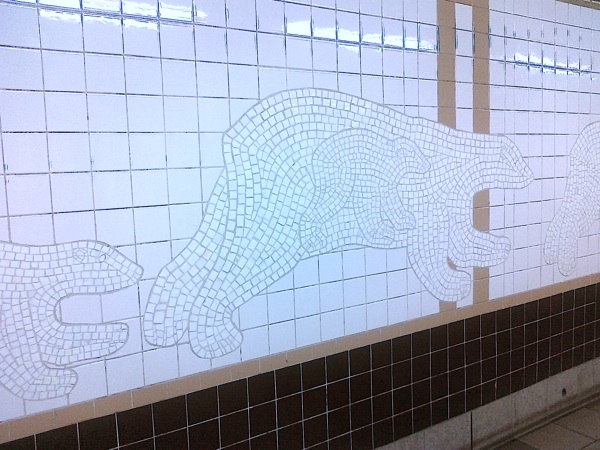
5th Ave / 59th St (CPS): Polar bears
Summer was hard
There was plenty for the media and spin doctors.
Abbas turned Netanyahu upside down, if not the entire Levant.
The pundits quacked and seemed resentful.
The water was black and would soon spill over.
Summer was hard, summer was hard.
Even money was frozen in the bank.
Saturday evening could only be celebrated
if they’d reach a peace accord amidst Arab Spring.
(Original poem by Bo Carpelan (1926-2011)).
Comment » | Category: ?? ????? ?????, Billed, Dikt | Schlagwörter: English, Gedicht, New York, Politik, Svenska
September 24th, 2011 — 10:48am
(i.a) During the final scene of Anna Bolena, a magic moment in the Met when Anna Netrebko, overwhelmed by the audience’s cheerful acclaim, slipped out of character and with a big smile applauded the orchestra, acknowledging their exceptional performance at the dress rehearsal.
(i.b) Set designers are modern magicians, with engineering skills.
(ii.a) Either my clothes have been shrinking due to professional laundry service, or my body has gotten really bloated due to excessive intake of food. I feel I cannot rule out either for sure.
(ii.b) Neither is a cure for my bloated ego.
(iii) A tv ad for the flawless face: An air void of all character and imperfection, is robbed of life’s essence itself rather than just the lines of time.
(iv) 12 Corazones makes me think I should consider learning Spanish, de veras! (15.09.)
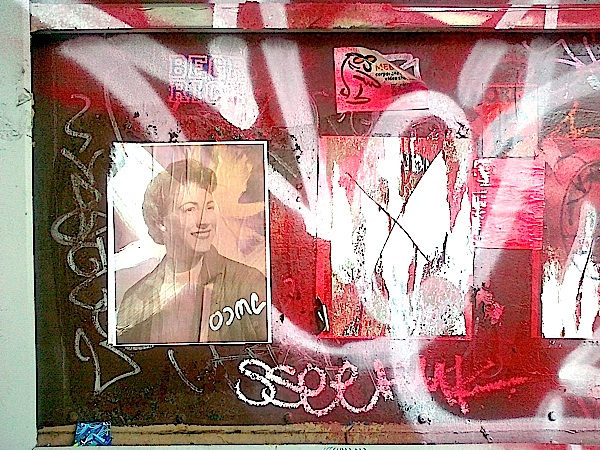
Lafayette St (bet Spring & Broome St, nr Petrosino Square)
(v.a) The Yankees just got drowned tonight by rain, and the match against the Boston Red Sox postponed to next Sunday as second game in a day-night doubleheader. (23.09.)
(v.b) Bagging one’s hair is among the smartest choices observed by me this day.
(v.c) Right at the exit of 161st St / Yankee Stadium, ponchos sold for five US-dollars a piece. A few steps further down the street, two sold for five already. The mechanics of free trade versus overcharging by a touting street hawk(er)s‘ cartel on the stairs up.
(vi.a) Kronos Quartet goes Einstürzende Neubauten: To watch, 30 years late, a group of middle-aged men banging hammers on scrap metal and using hand grinders next to cello, violin and viola, leaves me feeling seriously underwhelmed by their Awakening.
(vi.b) Low points of the programme were not limited to David Harrington emulating Blixa Bargeld’s vocals aghast and the all-too-cute Brooklyn Youth Chorus.
(vi.c) Sometimes avant-garde is just trying too hard – instead of delivering, spot-on, such as at the Met.
Comment » | Category: Billed, Miscellaneous | Schlagwörter: English, Kultur, Musik, New York
September 13th, 2011 — 7:21am
(i.a) Given my extensive consumption and ingestion of ß-carotene in form of baby-cut carrots (the finger food alternative to junk), I am probably in acute and imminent danger of carotenoderma.
(i.b) At least I don’t eat infants!
(ii.a) Addendum to V (i): W 82nd St, 1 am, on my way back from Music After, Rattus norvegicus enters the stage, scurrying up the stairs from a basement to my right, jaywalking the pedestrian path in front of me, then slipping under some perennials covering a tree pit, bowing out of sight.
(ii.b) NYC’s RIP: Is here the wish father to the thought? Are we channeling Freud?
(iii) Waking up to drum rolls and Amazing Grace played on the bagpipe, as a last farewell: „The sun forbear to shine“.
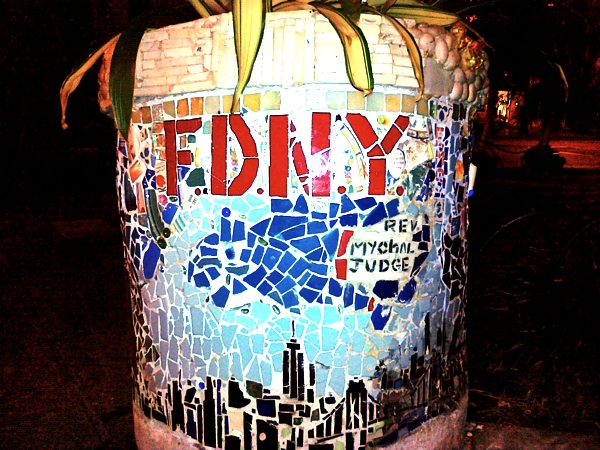
FDNY 9/11 - Tiles for America
(iv.a) A horrible slogan, based on fear-mongering: „Drive sober, or get pulled over.“ – Wouldn’t an appeal to reason do more good? Or a positive campaign, setting an example?
(iv.b) A terrible slogan, mismatching decency with disease, thus diminishing it as pathological: „If you see an elderly, pregnant, or handicapped person near you, please offer your seat. You’ll be standing up for what’s right. Courtesy is contagious, and it begins with you.“ – Just not as a medical condition, I’d hope, lest I be patient zero instead of merely polite.
(v.a) I have such a craving for chocolate. Let it not be Hershey’s!
(v.b) Never a more delicious, or superior taste as evidenced by this address line: Made by Cadbury UK Limited, PO Box 7008, Bournville, Birmingham, B30 2PT, UK. Found at Fairway’s!
Comment » | Category: Billed, Miscellaneous | Schlagwörter: English, Food, Kultur, New York
September 11th, 2011 — 1:27am
(i) Let me introduce you to New York’s fauna and its habitats: Mus musculus (a fugitive rodent at Westside Cleaners), Columba livia domestica (frequently observed on my window sills and the a/c), and the utterly abominable Scutigera coleoptrata, which ranks high among the most creepy extraterrestials ever.
(ii) An embarrassingly long-sought solution to a standard mathematical problem: t[h] = ((speed.A [km/h] + speed.B[km/h]) / distance [km])^-1. (See here if you wish to inquire what that means.)
(iii) How come all the jams I enjoy here in the States, are of Italian origin? First Fiordifrutta: Organic fruit spread: Raspberry, produced by Rigoni di Asiago Spa, Star-K kosher-certified, and now Pomegranate Raspberry: Organic Preserves by Mediterranean Organic, extra fruit, artisan crafted, „grown under the Mediterranean sun, […] picked at the peak of ripeness and processed in small batches on a 4th generation Italian family farm“.
(iv) A Gourmet Deli? No doubt, I must be in West Village, bordering on Chelsea.
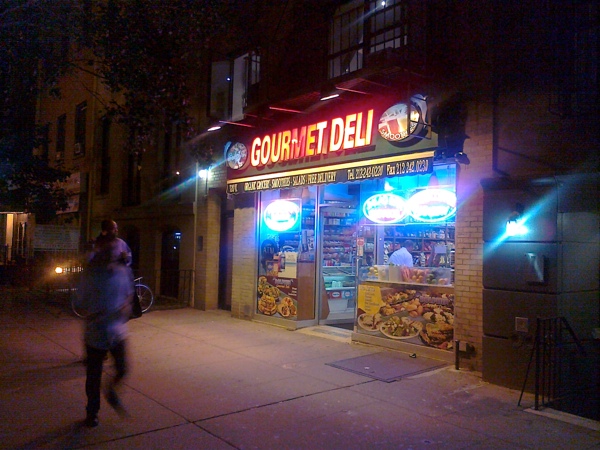
320 West 14th Street
(v) $800 for a dinner for two (omakase-style)? I’d rather go have cazuelas fajitas-style at hip Dos Caminos on the border to Meatpacking District, and then head over to Gaslight with its laidback, retro atmosphere.
(vi) I need my watch battery replaced. Looking for a dealer in the Manhattan yellow pages, I notice that 47 W St nr 5th Ave is the epicentre of New York’s watch-retail, -service and -repair – a.k.a. the Diamond District.
(vii) Spam: „The Jew Watch Project’s 1.5 Billion Pages Served Demonstrate Our Focus on Professionalism“. – What is wrong with you people?! About 1,500,000,000 skew reasons.
(viii) Do you also have a sense of epiphany with this Google Maps street view image?
Comment » | Category: Billed, Miscellaneous | Schlagwörter: English, Food, Natur, New York, Reise, Religion
September 8th, 2011 — 12:59am
New York, (p. 887)
city (area with water surface c. 365 sq. mi.; land only, 299; pop. 7,891,957), SE N.Y., largest city in U.S., on New York Bay at mouth of Hudson R. Comprised of five boroughs, each coextensive with a county: Manhattan, the Bronx, Queens, Brooklyn, Richmond (see Staten Island). The metropolitan area (1952 census, preliminary total pop. 12,831,914) includes industrial and residential parts of SE N.Y. and NE N.J. Many bridges and tunnels link the boroughs. With a magnificent natural harbor and over 500 mi. of water front, New York is largest port in the world. Extensive industries, chiefly consumer goods, are led by mfg. of clothing, textiles; printing and publishing; food and metal processing. Leading U.S. commercial (since 1840) and financial (stock exchange founded 1792) metropolis, it is a world center of banking (Bank of New York founded 1784 under Alexander Hamilton) and trade. With its vast array of cultural and educational resources, famous shops and restaurants, places of entertainment, striking architecture, colorful national neighborhoods, and its rich historic background, New York is almost unparalleled. Began with settlement (New Amsterdam) made by Dutch on Manhattan isl. in 1625. British seized control 1664. City divided in its loyalties, but Washington’s troops defended it until after battle of Long Island in Revolution. State cap. until 1797, first U.S. cap. under the Constitution (1789-90); Pres. Washington was inaugurated here. Until 1874, when portions of Westchester co. were annexed, city’s boundaries were confined to present-day Manhattan. Charter of 1898 set up five boroughs [NB: print text misspells „boroughts“] of Greater New York. Flatiron Bldg., first skyscraper, completed 1902; first subway, 1904. Many planning and administrative bodies (e.g., Port of New York Authority, 1921; Municipal Housing Authority, 1934) have been set up to cope with problems of the vast metropolis. Seat of permanent UN hq.
ex:
The Columbia Viking Desk Encyclopedia (in 2 volumes),
The Viking Press / Columbia University Press: New York 1953
Comment » | Category: ?? ????? ?????, 1953 | Schlagwörter: English, Geschichte, New York
September 8th, 2011 — 12:06am
Queens, (p. 1044)
borough (land area 108 sq. mi.; pop. 1,550,849) of New York city, SE N.Y., W end of Long Isl. adjoining Brooklyn borough. Separated from Manhattan and the Bronx by East R. (mainly bridges, e.g. Queensboro Bridge, built 1909, which stimulated borough’s greatest growth; and tunnel connections); on S is Jamaica Bay, separated from the Atlantic by Rockaway peninsula (c. 12 mi. long; resorts and commuters‘ communities). First settled by Dutch 1635; old Queens co. estab. 1683; divided 1898 into Queens and Nassau counties, when Queens also became a New York city borough (largest in area). Mainly residential as in communities of Flushing, with Flushing Meadows park (site of New York World’s Fair in 1939-40, later site of General Assembly meetings of the UN) and Queens Col. (see New York, College of the City of); and Forrest Hills (has West Side Tennis Club where national and international matches are held). Heavily industrialized in area of Long Island City (shipping facilities on East R.; rail yards; consumer commodities); also at Astoria and Jamaica (important railroad transfer point, with extensive business and residential sections). Has two municipal airports, both administered by Port of New York Authority – LaGuardia (558 acres; opened 1939) and New York Internatl. Airport (4,900 acres; opened 1948; sometimes called Idlewild). Here are Jamaica and Aqueduct race tracks.
ex:
The Columbia Viking Desk Encyclopedia (in 2 volumes),
The Viking Press / Columbia University Press: New York 1953
Comment » | Category: ?? ????? ?????, 1953 | Schlagwörter: English, New York, Reise, Wirtschaft
September 7th, 2011 — 7:50am
Brooklyn. (p. 171)
1 Village (pop. 2,568), SW Ill., on the Mississippi above East St. Louis. An all-Negro town. Post office is Lovejoy. 2 Borough (land area 71 sq. mi.; pop. 2,738,175), of New York city, SE N.Y., on SW end of Long Isl. adjoining Queens borough. Settled 1636-37 by Walloons and Hollanders; hamlet of Breuckelen estab. c. 1645; absorbed various settlements (e.g., Flatbush, a 17th-cent. Dutch village, now a residential section) until it became coextensive with Kings Co. (estab. 1683); became a New York city borough 1898. Separated from downtown Manhattan by East R. (many bridges, e.g., Brooklyn Bridge, and tunnels), from Staten Isl. by the Narrows of New York Bay. Though largely residential, borough has important port facilities – New York Naval Shipyard (commonly Brooklyn Navy Yard), Bush Terminal – and industrial establishments (machinery, textiles, paper, chemicals, shoes, processed foods). Seat of Brooklyn Col. (see New York, College of the City of); Pratt Institute; Long Isl. Univ. (nonsectarian; coed. [NB: print text misses period]; chartered 1926, opened 1927); St. John’s Univ. (R.C., Vincentian; partly coed.; opened 1870, chartered 1871); Brooklyn Institute of Arts and Sciences; and Long Isl. Historical Society. Here are Prospect Park (see Long Island, Battle of); Ebbets Field (home of Brooklyn Dodgers); Coney Isl., farmed beach resort and amusement center; and many noted churches. 3 City (pop. 6,317), NE Ohio, a S suburb of Cleveland.
ex:
The Columbia Viking Desk Encyclopedia (in 2 volumes),
The Viking Press / Columbia University Press: New York 1953
Comment » | Category: ?? ????? ?????, 1953 | Schlagwörter: English, Geschichte, New York, Wirtschaft
September 4th, 2011 — 5:46am
Manhattan. (p. 765)
1 City (pop. 19,056), NE Kansas […] 2 Borough (land area 22 sq. mi.; pop. 1,960,101) of New York city, SE N.Y., coextensive with New York co. Composed chiefly of Manhattan isl. (c. 12 mi. long and 2 mi. wide at greatest width), but also including islands in East R. and in New York Bay (Governors Island; Ellis Island; Bedloe’s Isl., with Statue of Liberty); bounded on W by Hudson R., NE and N by Harlem R. and Spuyten Duyvil Creek. Many bridges, tunnels, ferries link it to the other boroughs and to N.J. Dutch West India Company bought Manhattan from Manhattan Indians in 1626 for trinkets worth $24; first known as New Amsterdam, it became New York under the English 1664; its boundaries were those of New York city until 1874, when several Westchester co. communities were inc. into city; became a New York city borough 1898. Commercial, cultural, financial heart of the city, with extensive and diversified mfg., tremendous wholesale and retail trade, major distribution facilities (rail, ship, truck), banking and finance establishments. Here are Metropolitan Museum of Art, American Museum of Natural History, Museum of Modern Art; hq. of New York Public Library; numerous theaters (theatrical center of the country) and institutions of music, Columbia University, parts of College of the City of New York and of New York University, New School for Social Research, Juilliard School of Music, theological seminaries and medical schools, Cooper Union; Trinity Church (chartered 1697), Saint Patrick’s Cathedral, Cathedral of Saint John the Divine, Riverside Church, Temple Emanu-El. Famous areas: Harlem, Greenwich Village, the Bowery; streets: Broadway, Fifth Avenue, Wall Street; parks: the Battery, Central Park, Fort Tryon Park (with the Cloisters). Some of the much-visited buildings are: Empire State Building, Rockefeller Center, Jumel Mansion, and UN hq.
ex:
The Columbia Viking Desk Encyclopedia (in 2 volumes),
The Viking Press / Columbia University Press: New York 1953
Comment » | Category: ?? ????? ?????, 1953 | Schlagwörter: English, New York, Reise
September 4th, 2011 — 2:45am
Staten Island (p. 1212)
(57 sq. mi.; pop. 191,555), SE N.Y., in New York Bay, forming (with small adjacent islands) Richmond borough (since 1898) of New York city and Richmond co. of N.Y. state. N and W, bridges cross to N.J. over Kill Van Kull and Arthur Kill; ferries connect with Manhattan (NE) and Brooklyn. Generally residential, with some semirural sections and resort beaches (SE shore). Industries (shipbuilding and repairing, oil refining, lumber milling) mainly in N. Trade centers are St. George, Stapleton (site of first U.S. free port), Port Richmond. Staten Isl. visited by Henry Hudson 1609; permanent community estab. by 1661. Early buildings include Billopp (or Conference) House (built before 1688), where Lord Howe negotiated with Continentals in 1776; Church of St. Andrew (founded 1708); Garibaldi House (Italian liberator lived here in 1850s).
ex:
The Columbia Viking Desk Encyclopedia (in 2 volumes),
The Viking Press / Columbia University Press: New York 1953
Comment » | Category: ?? ????? ?????, 1953 | Schlagwörter: English, New York, Reise
September 4th, 2011 — 2:23am
Bronx, the, (p. 170-171)
northernmost borough (land area 41 sq. mi.; pop. 1,451,277) of New York city, SE N.Y. Settled 1641 under Dutch West India Co., became a New York city borough in 1898 and a co. of N.Y. state in 1914. On peninsula NE of Manhattan and S of Westchester co.; bounded on W by Hudson R., SW by Spuyten Duyvil Creek and Harlem R., S by East R., and E by Long Isl. Sound. Many bridge and tunnel connections to Manhattan and Queens. Mainly residential, though industrialized along Harlem R. Numerous parks include Bronx (zoo, botanic gardens), Van Cortlandt and Pelham Bay. Seat of Fordham University, Manhattan Col. (R.C., Christian Brothers; for men; opened as academy 1849, chartered as college 1863); parts of New York University, and Hunter Col. (see New York, College of the City of). Has Yankee Stadium and Poe cottage.
ex:
The Columbia Viking Desk Encyclopedia (in 2 volumes),
The Viking Press / Columbia University Press: New York 1953
Comment » | Category: ?? ????? ?????, 1953 | Schlagwörter: English, New York
